[ISF 189] research beginnings

 – Patrick Edward O’Toole –

The industrial evolution of human organization: “The role of science in social environments”.  

I am researching the historical development of scientific organization by studying the historical development of Human Resource Management, documenting transitions from (social) theory to applied social science, to determine if science-based human management and organizational disciplines can be applied to the field of social theory.

Practical problem: no way to verify the social theories I’ve been introduced to.

Research problem: identify scientific research on human behavior and social organization?

Research solution: study a cross-selection of relevant academic subjects here at Cal Berkeley.

Practical solution: conduct research based on my formal course of study, using ISF methods.

What is my statement or Question?  How has the integration of scientific methods and research changed the way people are managed and organized?  Can this research (in human behavior and organizational dynamics) help to answer the big-picture questions posed by social theory about human nature, social organization, individual capacity, the role of structure and agency?

1.  Research problem: It has been 147 years since Marx published Das Kapital, 109 years since Weber published The Protestant Ethic and the Spirit of Capitalism, 91 years since Freud published The Ego and the Id.  In the same time period that science has launched the Hubble telescope 347 miles above the earth’s surface (capable of detecting light 1 billion times fainter than the human eye can see, the lense of which was constructed in zero atmosphere conditions to avoid warping in space and installed by people floating in space suits) leading to breakthroughs such as accurately determining the rate of expansion of the universe, DNA sequencing has traced organic evolution to its microbial beginnings 4 billion years ago and human beings are regularly having heart and lung transplants from harvested organs- results and techniques that are fundamentally agreed upon across all cultural, linguistic, ethnic and gender variation- there is no agreed upon consensus of why people behave as they do, how they should behave, if there’s an ideal environment humans are disposed to, or the proper social organizational structures.  In an environment of such methodological development and scientific progress, how can this be?

Social theories are frameworks used to study and interpret social phenomena.  They are tools used by social scientists to construct plausible explanations for human behavior and social conduct.  Social theories can be seen as large-scale Interpretations that identify and interpret the underlying causal factors in human social interactions.  Difficulty seems to arise arises in this theoretical phase.  It is always possible to assign meaning and causal properties.  One could spend an academic career reading Interpretations across time and culture of how various peoples have assigned meaning to reality, who suffered no obvious consequence regardless of how little these meanings correlate to reality.  The dilemma is that people inevitable attempt an extension beyond the scope of the situation.  This extension exists as a theory- a cherished and useful tool.  This attempt at extension is as dangerous and as dubious for the average person as it is for the trained social scientist.

The process is always the same; people draw conclusions/make Interpretations based on ideas formulated from some sort of experience and exposure.  The qualitative difference- what distinguishes a social scientist from someone with an opinion- is the quality of their process, involving testing, reading, examination, re-testing, collaboration, formal education, and the use of established methods and tools, to establish a knowledge-base foundation for their theory.  In this manner, social science is deliberate, organized, and documented- attempting to operate outside of bias and limitation.  It is an active process in which the observer tries to understand the observed as it is.  One observation is that, however scientifically derived data may be, the Interpretative process still applies, and with it the same considerations and concerns.  This is exemplified in social theory, as the accuracy of the interpretation need not have any basis in reality.  Phoenician sailors were able to accurately observe and analyze the motion of the stars and create highly specific navigation, and were concurrently able to interpret the celestial bodies using Greek and Egyptian mythology, without disaster or lack of accuracy.  The accurate assessment that something is and ability to predict what may happen does not preclude in any way a factual understanding of Why or How.  This is the breakdown and joy of theorizing, and the troubled waters a social-theory-based student has to consider when trying to conduct a social science project.

2.  Methodology:  Having no formal scientific training it would be difficult to assume capacity to conduct formal scientific inquiry.  As an interdisciplinary studies researcher, there is little available in the manner of formal descriptions, defined terms or established methods.  Internet searches of Interdisciplinary Research reveals a general consensus that it is an advanced procedure to be done in collaboration with other senior academics, to understand social phenomena which requires methods and analytic capabilities that spans traditional academic boundaries.  There is no established academic procedure that can be referenced and modeled; no pre-established methodologies to be borrowed from and used as guides and signals of how to conduct this kind of research.  ISF is thus better described not as interdisciplinary training but as non-disciplinary academic training with a unique opportunity to sample information from various sources.  The potential of this approach was powerfully illustrated in the reading of Essence of Decision, an example that can stand alone in demonstrating the power of examining phenomena with as many tools as possible.  This provided for me a very strong case for answering “why” regarding the importance of developing a “cross-disciplinary Research Program” approach.

It seems wise to consider Essence of Decision and the information provided in ISF 189 as a combined methodology for this research project.  Critical reflection of ISF 189 is that it has offered a very strategic set of tools to investigate, analyze and conduct social science research outside of any particular academic style or method.  I am operating under the assumption that my research will lead me to three information formats:  the literary paper, the experiment, and the statistical model.  I need proficiency in analysing these formats and in determining the quality and validity of the information presented- as possible source documents to use in constructing my research.  The below represents the tools and resources of my research.

  • Critical Reading (Vallee):  as document analysis techniques.
  • The Craft of Research (Booth):  as the structure and method for inquiry.
  • Comparative Historical Methods (Lange):  as the methodology for comparative analysis.
  • Essence of Decision (Allison):  as the template for cross-disciplinary analysis.
  • Gilens & Page + Martin: as examples of deciphering research projects.
  • Naked Statistics (Wheelan): as the guide for understanding statistical information.
  • Writing for Sociology (Jones): as the resource manual for writing.

The various research documents provided in ISF 189 are seen as illustrating the extensive variety of possible research methods that can be employed.  From highly conceptual Sociology to hard-line analytics in Political Science, there are many valid approaches to investigating social phenomena and conducting research.  This research project will begin with populating the basic areas recommended by Booth (2008). 

Name the Topic: what you are writing about?   I am researching the historical development of scientific organization in the field of Human Resource Management

Ask the Indirect Question: what you don’t know about it?  to document transitions from social theory to applied social science

Answer the “So What” / Significance:  to help my reader determine if modern science-based human-management and organizational disciplines are providing insights and answers to social theory.

3.  Research Strategy:  I am compiling a list of research links, online resources, writing guides and potential source documents.  I have read the ISF 190 Thesis Guidelines http://live-isf.pantheon.berkeley.edu/isf-senior-thesis-guidelines and will use the online library resource  for ISF 190 to organize my research http://guides.lib.berkeley.edu/course-guide/193-ISF190.  I have contacted various academics who are familiar with my research focus (Berkeley, S.F. State, Stanford, U.C.L.A.) and have been directed toward articles to begin my research process.  My Course of Study has made available several academic disciplines (Organizational Sociology and Industrial-Organizational Psychology) that are key to my research and I will be using both the information and (hopefully) the professors as resources.  I have no intention of conducting experiments but will be looking for definitive studies in academic journals.  This research project will be historical and comparative in nature.

4.  Hypothesis:  human social organization has witnessed countless iterations within the span of recorded history.  The past several thousand years have seen the development of guiding principles and theoretical frameworks that have been used to construct and justify social arrangements.  I assume a combination of traditions, cultural inertial, environmental conditions and biology to be the basic determinants of social organization in which continuity was provided by oral tradition and traditional role-modeling.  What is essential to my research is the assumption that social groups for the past 10-100 thousand years have been assigning meaning, making extensions, and creating elaborate theories to explain how and why they as societies (and people) do what it is they do.  The rational-cognitive mechanisms employed were based on some form of Socratic method and/or direct knowing (spiritual/religious) that did not change until the time period referred to as Modernity.  According the Weber (2009) although we recognize the existence of science (like capitalism) in various social environments for the past several thousand years, the deliberate and organized, rational use of science is quite recent, and its employment toward academic social issues even more so.  My argument is that human disposition (via evolutionary selection) is wide enough to encompass a variety of social arrangements and personal preferences that are mutually exclusive without being necessarily better suited to human nature which is why social theory can be so varied and contested.  My question is, has the application of scientific investigation helped to solve these theoretical dilemmas.

Rubric for Social Theory:  Social Theory is an attempt to understand the social transformations beginning around 1500, commonly referred to as Modernity. Social theory was produced not just to create an understanding of these changes and the problems they caused, but also to be used to propose how society ought to be structured. Classical thinkers (Marx, Weber, Durkheim) proposed how to analyze those changes, and in doing so created theories of society.  Modernity has been understood as the emergence of the bureaucratic state and development of the modern capitalist economy (ISF 100A/F), the decline of religious authority as the main arbiter of moral values and the rise of the self-interested purposive actor (ISF 100B), and the use of science to develop new technology (ISF 100G).

Theoretical considerations:  Evolution is based on the idea that variation and change (e.g difference) = survival.  There may be no ideal environmental/cultural/organizational situation for all human beings as that would imply a static homogeneous environment and the end of change which would limit the possibilities of our species.  Variation and difference are the essence of our survival strategy.  The strategic gift for humans is our unformated “empty space” which leaves humans capable of intragenerational learning that allows for cultural/environmental programming in a single generation, and the capability for dynamic transformation within a single lifespan.  Children receive thousands of years of cultural evolution in a decade. The “empty space” is the gap of possibility- and also of doubt and the unknown.  Normative behavior is the solution and the trap.  The trials and difficulties of modern social living go hand-in-hand with the massive developments of the past 150 years.  The creative space exists in the unknown.  This is the basic evolutionary human dilemma.  Changing what is know to work can be deadly, but as all things change, the same behavior will at some point be non-adaptive.  This “gap” is what gives humans the wide range of adaptive possibilities they possess and may also explain why it is so hard to pin-point causal factors for human behavior or determine specific ideal circumstances for social organization.  There may be no single answer but a wide range of possibilities available through our adaptive mechanisms that makes highly differentiated beliefs, organizational strategies, and structured relationships possible.

It is also probable that, as an evolving species, even the truths we discover about ourselves will, over time, no longer be applicable.  If evolution is indeed the mechanism, there will come a time when our descendants will no longer be human, no longer be homo sapien sapiens, no longer have similar brain structure, similar cognitive capabilities, similar predispositions, morals, beliefs, and social dynamics.  What this means is the topic for science fiction and not for this research paper, yet an important consideration for theorizing in a social science environment.  The ideal circumstance may be freedom to construct in an environment that requires ongoing construction (evolution), recognizing that people generally like stability and find change disturbing, and that the very social construct that makes new change (new construction) possible is also a limiting factor in impeding its development.


A Wide Range of Possibilities.

 – Patrick Edward O’Toole –

baby hippo

evolution is  based on the idea that variation and change: difference = survival……there may be no ideal situation for all beings b/c that would imply a static homogeneous environment and the end of evolution and change….which will not happen…or if it does, will begin to limit the possibilities of the human organism.  variation and difference is the essence of our survival strategy as a species.  the ultimate “gift” or strategy for humans is the “empty space” open for intragenerational and single generational learning that allows not only an entire cultural/environmental reprogramming in a Single generation, but the capability to learn within a single lifespan and have dynamic transformation.  We raise children and give them thousands of years of evolution in a few decades.  evolution strategy is to make things different….different enough to defy prediction?  the “empty space” is the gap of possibility…and also of doubt and fear and the unknown.  normative behavior is the solution and the trap.  the trials and difficulties of modern social living go and in hand with the massive developments of the past 250 years.  The creative space in the unknown.  this is the basic human/anthro-delima.  “maybe we should try some different berries and try a new path across the frozen lake this year = gonna die…but b/c of the natural changing process at some point the berry won’t be the same and the path won’t work anyway…disruption from the known is primarily dangerous and the opportunity of growth and change.

bored-baby


this “gap” is what helps make us so adaptive, what gives us the range that we possess, that lessens the governor other organisms have on determining their fate, and why it is so hard to pin-point exact human behavior or determin highly specific ideal circumstances for social organization….there may not be this option…but a wide range of possibilities.

Organizational Sociology and Business Strategy

 – Patrick Edward O’Toole –

A firm’s organization’s culture may provide a sustainable competitive advantage when it can create superior financial performance through a unique organization of internal resources (such as its organizational culture) that can not be copied by competitors.  Three conditions must be met for this to happen.  The culture must be (1) valuable: it’s activities lead to high sales and low costs.  (2) rare: there are characteristics uncommon to competitors.  (3) imperfectly inimitable:  attempts to imitate will create some sort of disadvantage to imitators.  This organizational culture will be comprised of unspoken, even undefinable patterns, agreements and expectations that “become part of the unspoken, unperceived common sense of the firm.” making it difficult to define and (hopefully) impossible to imitate.  Concurrently, a firm can modify its organization culture to gain a sustainable competitive advantage if it has valuable, rare, and imperfectly inimitable culture management skills to alter its organizational culture and create superior financial performance for the firm.

Sociologists seek to explain and predict behavior of large populations of firms and organizations, looking for trends and explanations diffused from the examination of multiple organizations.  Sociologists consider the social, historical and political influences in which an organization is formed and exists within, observing the impact of the socio-historical milieu upon the structure and behavior of firms.  Strategists are optimistic about a firm’s capacity to shapes its future according to plan and decision.  They focus on market factors with significantly less emphasis on historical, political, and social factors.  The overarching mission of strategists is to identify how firms gain efficiencies through strategy, creating prescriptive models used to make organizations more efficient.

DiMaggio and Powell argue that organizations tend toward homogeneity regardless of their intentions.  “Today, however, structural change in organizations seems less and less driven by competition or by the need for efficiency.”  They observed powerful tendencies toward organizational similarity that come from organizational needs (legitimacy; uncertainty) not necessarily rooted in strategy.  “Organizational change occurs as the result of processes that make organizations more similar without necessarily making them more efficient.”

According to DiMaggio and Powell, organizational form and structure are influenced by concerns of legality, uncertainty, and legitimacy that can trump organizational plans to differentiate from competitors.  This process occurs regardless of strategic intentions.  “Once a field becomes established, however, there is an inexorable push toward homogenization.”  DiMaggio and Powell identified this process as institutional isomorphism, an environmental dynamic that “constrains their (organizations) ability to change.”  DiMaggio and Powell do not refute the power or presence of strategic planning; they point out that firms are subject to constraints and pressures that shape organizational choices regardless of intention and planning.  Whether change by external forces (coercive), imitating other firms to manage uncertainty (mimetic), or changing to create legitimacy (normative), organizations trend toward similarity due to these social, political and historical forces that shape the society in which organizations exist.

As sociologists, DiMaggio and Powell would find Barney’s statement idealistic, failing to understand and account for the overarching influences of laws, social pressures, changes in institutional fields, and human reactions to uncertainty and desires for legitimacy that force and demand some quantity of unavoidable similarity.  “Organizational structures increasingly come to reflect rules institutionalized and legitimated by and within the state.”   DiMaggio and Powell would disagree with Barney’s statement in that it suggests it is possible to sustain highly specific organizational differentiation over time; i.e. possible to avoid imitation.

Further disagreements would revolve around the real need for organizations to adopt similar practices and forms to adapt to environmental challenges.  In effect, successful imitation is both unavoidable and necessary.  Similarities allow for the transfer of human assets across organizations, creating an interchangeability which is strategically important.  Failing to adopt industry standards could create legal issues as well as decreased public perceptions of legitimacy.  Having an organizational culture so different from other players could make integrating new agents and adaptation to new technologies very difficult over time and create uncertainty with consumers.  DiMaggio and Powell also point out that strategic differentiation might not be very possible due to a real lack of options “despite considerable search for diversity there is little variation to be selected from.”

Since organizational fields are subject to social and technological pressures and deeply influenced by public perception, successful imitation will be necessary to a sustained competitive advantage.  DiMaggio and Powell would thus disagree with Barney, asserting that

(1)  organizational imitation is unavoidable and inevitable.

(2)  organizational imitation is essential to survival.


Reference Page

  1. Barney, Jay B. “Organizational Culture: Can It Be a Source of Sustained Competitive Advantage?” The Academy of Management Review 11.3 (1986): 661
  2. Dimaggio, Paul J., and Walter W. Powell. “The Iron Cage Revisited: Institutional Isomorphism and Collective Rationality in Organizational Fields.” American Sociological Review 48.2 (1983): 147
  3. Dimaggio, Paul J., and Walter W. Powell. “The Iron Cage Revisited: Institutional Isomorphism and Collective Rationality in Organizational Fields.” American Sociological Review 48.2 (1983): 147
  4. Dimaggio, Paul J., and Walter W. Powell. “The Iron Cage Revisited: Institutional Isomorphism and Collective Rationality in Organizational Fields.” American Sociological Review 48.2 (1983): 148
  5. Dimaggio, Paul J., and Walter W. Powell. “The Iron Cage Revisited: Institutional Isomorphism and Collective Rationality in Organizational Fields.” American Sociological Review 48.2 (1983): 148
  6. Dimaggio, Paul J., and Walter W. Powell. “The Iron Cage Revisited: Institutional Isomorphism and Collective Rationality in Organizational Fields.” American Sociological Review 48.2 (1983): 147
  7. Meyer, John W., and Brian Rowan. “Institutionalized Organizations: Formal Structure as Myth and Ceremony.” American Journal of Sociology 83.2 (1977): 340
  8. Dimaggio, Paul J., and Walter W. Powell. “The Iron Cage Revisited: Institutional Isomorphism and Collective Rationality in Organizational Fields.” American Sociological Review 48.2 (1983): 152

Creative Destruction and Open-Access Societies

9781107646995i

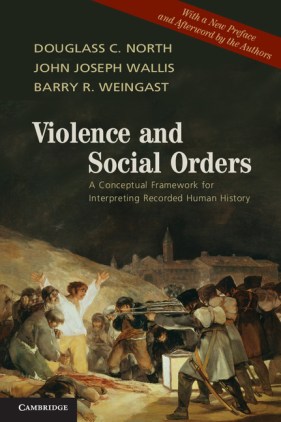
Douglas North (& Co.) published Violence and Social Orders in 2009 to offer, in his own words, a conceptual framework for interpreting recorded human history.  The reader will find strong evidence of anthropology, sociology, social psychology, economics, law, and political theory.  A cornerstone work of political science.  Although it lacks the total volume of Marx or Weber, it is equal in scope and universality, providing a theoretical framework that explains the causal forces of historical human social organization.  The concepts are categorically less supermundane and much easier to work with.  As a student unfamiliar with political science this has come as relief after a year of Marx and Weber.  As a plausible framework it offers a consistent explanation of society, organizational structure, economics, politics and law that is organized, rigorous and very well documented.

Violence and Social Orders offers a unique explanation of human society, emphasizing violence-management as the key dynamic within social construction.  In effect, the process where by which a given society manages its human-violence-potential determines the quantity and nature of the other social properties.  The possibilities and limitations of institutional and organizational development, civic participation, etc, are determined by the mechanism of violence-management employed by a society, hence the title “Violence and Social Orders”.

Of primary consideration is North’s claim of empirical evidence that proves economic growth to be directly correlated with open access societies (explained later) and less correlated with repressive social orders (Natural States); that entire geographic regions can be economically assessed (even over thousands of years) in terms of expanding and retreating economic development, to prove that geographic areas and countries which remain economically regressive in comparison to the West, are so to the degree to which they are/have not been free, democratic, impartial, and egalitarian over time (pgs 4-5 table 1.1 & 1.2).  This of course is a huge claim statement that, if correct, offers major considerations regarding past and current social orders, such as Western capitalism, socialism, and communism (China most specifically).

This essay will identify North’s primary concepts and how they are employed to explain social reality.  Later pages will explore the extent to which the book lives up to its title (and claim) of explaining human recorded history.  Final writings will explore the scope of North’s conceptual framework and how it explains social phenomena beyond capitalism proper.

According to North, the primary concern of all human social orders is the regulation and management of violence.  In scope, this book reaches back beyond the Agricultural Revolution and claims strong evidence of social violence based on archaeological findings.  North asserts that social violence was much more pronounced in our ancestral past; that the primary social order of hunter-gatherers (referred to as foraging order) of human society were in fact the most violent (pg 75 table 2.1).  With this as his backdrop, Violence and Social Orders (2009) charts human  history from the Agricultural Revolution (8K-10K years ago), claiming all social orders that followed (until quite recently) to be various iterations of what he refers to as Natural States.

Natural States are defined by the manner in which they employ ‘rent creation’ as the mechanism for social order vis-à-vis violence management, and North identifies three phases/types.  Fragil; Basic; Mature.  The word “Natural” is used because, for the last 10K years it has been virtually the only form of society (larger than a few hundred people) that has been capable of creating order and managing violence.  Simply stated, it has become natural to people to organize under these conditions.  Natural States are structured with (1) an elite body of stakeholders and (2) the vast majority of people controlled and disenfranchised from power or resources, with access to the governing body for the most part closed off to all but the Elite- of limited access.  This basic dynamic is held in place by rent-creation.

Rent creation is the process of manipulating an environment to gain access to greater portions of the available resources without necessarily adding value.  It is the traditional society as described by Weber, in which status, class, and association are determinant in one’s access to resources.  North describes this rent creation process as essential to understanding the Natural State construction.  In the Natural State, elite players have created a situation where they command resources from average, controlled, agents.  As long as the elites observe that it is more beneficial for them to get rents in a stable social environment, and less advantageous in a conflict situation, this maintains peace.  In the various stages of Natural states, the ever-constant agenda of unequal access to resources by the elites (rent creation) is the underpinning of social stability- and the road-block to equality and impersonality (the foundation of open access societies).  Natural states rely on rent creation as the building block of social control, and the degree to which it is present is also an indicator of the degree to which a society is distanced from an open access environment.  Rent creation is important to Natural States as there can be no Natural State without rent control.  Rent creation and Natural states are to North, synonymous.

These are some important delineations between Natural and Open Access orders and specific characteristics of North’s social theory.

  • North does not suggest a teleological framework or the assertion of destiny.  North’s framework offers no utopian eventuality, does not decree that the Universe, or innate human disposition, or anything else will ensure or direct human social order.  Societies can and do slide into violence and instability or transition into egalitarian and open access environments.  Open access is not an inevitability or an eventuality orchestrated by universal laws or innate human disposition.  There is no end-goal in North’s presentation.
  • Natural States are by nature repressive and limit the development of social organizations in favor of control and the benefits this control extends to the elite stakeholders.
  • North asserts that the Natural State is the most common, most used, and thus the default model that humans have been using since the beginning of the agricultural revolution.  North asserts (countering Marx) that the Natural state is our default organizational model and more akin to human disposition; not a staging point in our transformation toward a “better future”.

As was stated in the introduction, all other aspects of society must conform to its mechanism of violence management control.  As such, there is a huge social trade-off for a rent-controlled society.  Complex organizations, be they political, economic, social, civic, education, etc, are all subsumed to the needs of controlled repression.  The difference between Fragile, Basic, and Mature Natural States is in the quantity and quality of the various social organizations allowed for by rent-controlling elites.  Elites must surrender ever increasing degrees of their private control (of violence) in order for there to be openness and organizational freedom.  Which brings economic success and great competitive advantage to the entire society, but in effect dethrones the independent violence- controlling elite as the shareholders of success, resources, and power.  A society can become open-access only as the elites become incorporated into society and surrender their specific control of violence.

North asserts that the Natural State is more akin to human disposition, but that it is possible to move toward (not forward) to a more open access environment…and just as possible to move toward a more destabilized Fragile State as well.  One of the fundamental differences between Marx and North is the very deliberate lack of assertions of inevitability (from North) regarding the progress and destination of humanity.  Marx believed in an implicit disposition of human nature that would eventually realise its destiny in a transformed human society.  North decidedly does not agree.  Open Access societies are equivalent to the Weberian description of a bureaucratic society.  Impartial laws, equal access, organizational freedom and constant development, equal participation, political freedom, rapid economic growth, etc.  In Open Access societies, violence management has been removed from individual hands and placed with the State, that has layers and controls in its use.  Political openness and access ensures that no one player or party can steal or co-opt power, and rent control evaporates in an environment of earned privilege and merritt.   North places Open Access societies as a very modern construction, no more than a few hundred years old.  This is why he used the term “Natural State” in reference to human historical social order.

It is possible under certain conditions for societies to shift into open-access societies.  Open access meaning nothing less than (ideally) having all aspects of society; politics, economics; civic participation, etc open to all citizens and protected by bureaucratic mechanisms that recognize and reward merit – the opposite of traditional societies, which is to say rent control, which it to say, limited access, or Natural States.  The conditions are referred to by North as Doorstep conditions.  North is clear that there is no prescriptive or homogeneous set of conditions to explain or predict this, but that the important feature is the decision of elites in a Mature Natural State that it is in their best interest to let go and allow the transitioning into an open access environment.  Key to North’s understanding of the growth-power and the access-protection mechanism of Open Access societies is Schumpeter’s concept of creative-destruction.

Open Access societies employ an entirely different violence-management dynamic, one that specifically reflects (and creates) the impersonal bureaucratic and meritorious social arrangement found in western-style constructions.  North points out that violence, in Open Access, has to be removed from individual employment, as all levels.  There is no place for power-wielding elites who control social organization with their violence-potential.   Power/the use of violence becomes departmentalized, meshed into other departments of a complex system that regulates with predictable checks and balances to ensure that violence can not be co-opted by charismatic individuals or casually employed even by elected officials.  Violence becomes bureaucratized, “owned” by the State, and used by officials who can be removed from position at any time if their actions do not reflect public opinion.  Similar to Weber’s description of the State’s monopoly on violence/legitimate use of physical force.  Thus society is a system (ideally) influenced by all and owned by none.  No person, no party, no group, can solidify power, as the creative destructive process that is synonymous with open access societies (as rent creation is synonymous with Natural States) provides for growth, equal opportunity, legal equality, and equal participation (=) Open Access.

North is very intent on emphasizing the power of creative-destruction in open-access societies and identifies it as the key variable upon which equality, economic development, the exchange of power, and the ongoing and overall economic growth this process calls forth.  It is fair to say that North choose to Not highlight the aspect of social turmoil that Schumpeter is explicit about in his own writings on the subject, nor the social costs associated with this process.  For North, this social dynamic is exactly what keeps open access societies fresh, and denies the consolidation and stagnation of political or economic power with any particular group.  As a reader who has currently discovered Schumpeter there is an impression that North employed an idealized presentation of the subject.  His description of Open Access societies read much like a high-school textbook on American History; it predictably extolled the virtues and successes of the system as it should work in its most simplistic description, while failing to mention stickier subjects like war, poverty, inequality, violence, crime, ect.

North identifies open access as the most economically profitable form of social organization.  The charts provided in the first chapter make it clear that growth, innovation, prosperity are directly linked with conditions of open access and freedom of participation.  The dynamic possibilities of Schumpeterian entrepreneurialism, of rapid and continuous economic and technological growth go hand in hand with the evolution of social freedom and the right to participate.  Open access as such is synonymous with the amazing growth and development of modern industrialized societies.

North points out quite aptly the specific and essential relationship between civic freedom (i.e. voting, non-discrimination, impersonality before the law, meritorious social arrangements, ect) and the unparalleled growth and development in the modern western societies (and of course non-western societies that have thoroughly adopted these social standards).  It is imperative to understanding Open Access that this dynamic be understood.

North asserts that growth and development (Capitalism in the Schumpeterian) exists to the degree in which people are free to create and develop complex social, civic, political, and economic organizations.  His main point with this is of course that a society which employs rent-creation, and its complementary social repression/unequal-access must de facto (and in Mature Natural States de jure) limit the activities, expression, creativity, and most important to his work, the economic growth and capacity of a given people/region/society.  Having read Schumpeter and finding strong personal agreement with his presentation, this model makes  sense and seems to work when applied to social circumstances.

Considering the scope (human history) and the unit of measurement (societies) North’s concepts are graspable, useable, and directly address the issues of concern both for the field of political economy and the general concerns of modern social inquiry.  For those who are politically, philosophically and morally inclined to concepts of western democracy and its relationship with capitalism, understanding where “we” have come from, what our expressed inclinations are (Natural State), and an acceptance (according to North) that there is no expected teleology of an evolved human state that we can rely on or hope for, it makes this inquiry of imminent importance.

Does book  live up to its subtitle?  “Framework for recorded history”

In regards to this book living up to its subtitle as a Framework for recorded history, this author would tend to agree that it has indeed done so.  It provides a solid, big picture frame on which to place various social entities and a description of structure and causality that seems to work very nicely.  This book is a quality complement to other social theories I am familiar with, and address the basic questions of how and why from a fresh (to me), political/economical perspective.  The terms and scope is graspable, and the excellent historical examples provide not only a fascinating insight to events but also verifies the depth and capacity of the authors.  I experienced an undeniable rigor of investigation and mastery of fact that was important for me as the reader.

Does the book go beyond narrower concept of capitalism to give broader framework of understanding?

North’s concepts directly assist in fleshing out and highlighting key components of social theory; freedom, equality, law, growth, ect.  He addressed economics, law, organizational construction, human behavior, and political organization.  This book is as much a work of sociology as it is that of political science and history.  This represents a very nice complement for an historical framework.  As was stated in my introduction, “Although it lacks the total volume of Marx or Weber, it is equal in scope and universality, providing a theoretical framework that explains the causal forces of historical human social organization.”

This being said I would not feel comfortable with North’s book as my only reference to human social development, history, motivation, and human potential.  It is a very bold statement to assert that humans are disposed/inclined to live in top-down societies in which strong-man dynamics rule.  That anthropological science points to increased human social violence in hunter/gatherer societies.  This framework does not investigate the role of beliefs, the (direct) relationship between specific technological innovations and social organization, the impact of rational science, or the rise of bureaucracy in relationship to economic growth and its concurrent influence on social construction.  Not that anything in the book/theory is wrong, but more so that there is much that could be added to the understanding of important causal factors that have influenced and shaped social organization over the past 10,000 years.  This being said, I am quite sure that Violence and Social Orders deserves many readings, after which I might very well reconsider any of the above criticisms.

can’t seem to stay away

Porter’s 5 forces is an external/environmental model of analysis.  The 5 forces are specifically

  • existing competition: the competitive relationship in the organizational field/marketplace
  • bargaining power of suppliers:  level of dependence/ who has more leverage
  • bargaining power of consumers: level of dependence/ who has more leverage
  • barriers to entrance: laws/costs/difficulties getting established
  • substitutions: possible options / replacements for the consumer
  • compliments (add on to the original 5 forces): other items/services the make the item more desirable and dispersed.

The 5 forces assumes that strategic positioning of the firm creates sustainable competitive advantage.  By analyzing the marketplace, the environment in which the firm exists, the firm can identify opportunities and threats, know when to enter and leave the marketplace, know how to respond to changes and how to position the firm for best results.  The 5 Forces is an external focus, precluding attention on internal resources; it presumes a homogeneity of resource distribution/ the mobility of resources, and as such sees positioning and external analysis as the arena in which to create sustainable competitive advantage.  It is not strategy per se, but guidelines of where to gather data and where to look for advantage.


Barney resisted the focus on external positioning countering that sustainable competitive advantage can and does come from internal resources.  It is an internal, resource-based analysis model.  Barney asserted that there are three types of resources: physical; organizational; and human, and that these resources could be a firm’s sustainable competitive advantage.  This suggests resource immobility; a heterogeneous distribution of resources amongst competitors and the possibility of creating create sustainable competitive advantage that could not be replicated by the competition.  For a resource to offer a sustainable competitive advantage it has to be these 4 qualities.  Valuable; Rare; worthy of imitation; have no replacement/equivalent.


A sociologist would criticize the lack of/minimizing of political, historical and social forces that shape organizational structure and behavior.  She would point out patterns of isomorphism, organizational tendencies to search for legitimacy and security, the irrational perceptions of problems and solutions, structural inertia and difficulties of changing; the fact that organizational behavior was reflective of traditional behavior and not of rational decision making on the part of most internal actors.  She would note that the very process of strategy would reflect (to some degree) the personal goals of stakeholders, and that many organizational decisions reflected organizational goals not in alignment with stated mission or economic plans.  She would also criticize the premise of the rational actor model in general and the presumption of ahistorical values that are projected on all societies (and people) as if there was universal similarity of expectations and desires across time and space.


Resource Dependence asserts the immobility of resources such that a competitive advantage can exists in the internal resources of a firm.  Stinchcombe asserted that organizations were and only could be created with the existing social technology available.  That an organization was, in fact, limited in form and function by the society in which it was formed.  Furthermore, that the organization would hold onto features of the original time/place even in the face of newness and competition.  If this is true, it is not obvious that an organization would be free to create an unlimited or unconditional internal competitive advantage;  if the social technology was not present, however advantageous a process might be, it would not exist as a possible creation for the organization.  Also- if organizational form persisted over extended periods, it might reflect a population ecological view that an organization would hold onto older forms regardless of the opportunity to innovate a new competitive advantage; it might not/would not necessarily change.  In general, any sociologist would take umbrage with any organizational model that failed to emphasis the importance of social, political and historical forces on organization action and behavior.  To simply ignore the greater social milieu in which an organization exists would be a fundamental flaw in any model including Resource Dependence.

hard at work

Carl Marx believed in a universal dialectical process, that played itself out in the human realm as conflict between classes.  He suggested an implicit disposition of human nature that would eventually realize its destiny in a transformed human society, referred to as Communism.  Well know political scientist Douglas North, conversely, asserted that humanity/human society existed on a sliding scale of organization, from fragile natural states to open access societies.  North asserted that there was no implicit destiny that human society would eventually arrive at. North, furthermore, asserted that the “natural state” (i.e. power dominance and elite-class rulership) was more akin to human disposition, but that it was possible to move toward (not forward) a more open access environment…and just as possible to move toward destabilized fragile states as well.

In this “Natural State”, elite players have created a situation where they command resources from average, controlled, agents.  As long as the elites observe that it is more beneficial for them to get rents in a peaceful situation, and less advantageous in a conflict situation, this “keeps the peace”.  In the various stages of natural states, the ever-constant agenda of controlling society to have unequal access to resources by the elites (rent creation) is the underpinning of social stability, and, the road-block to equality and impersonality, the foundation of open access societies.  Natural states rely on rent creation as the building block of social control, and the degree to which it is present is also an indicator of the degree to which a society is distanced from an open access environment.  Rent creation is important to Natural States b/c there can be no Natural State without rent control (according to North).  Rent creation and Natural states are to North, synonymous.

According to North there are strong and very specific delineations between Natural and Open Access orders.  He asserted that the Natural state was the most common, most used, and thus the default model that humans have been using since the beginning of the agricultural revolution 8-10 thousand years ago.  He believed (unlike Marx) that the Natural state was the default organizational model, not an inevitable Communist or Open Access state.  According to North, the issue of controlling and regulating violence is a key necessity of all social organization, and humans are most naturally disposed to have an elite community that imposed rent-control conditions on the group and who use this as the mechanism to enact social order.  It is important because it offers no utopian eventuality, does not decree that the Universe, or innate human disposition, or anything else will ensure or direct human social order.  It is also a reminder that societies can slide into violence and instability as well as move “forward”.  Those committed to open access societies must realize that open access is created, must be worked for, and must be maintained.  Equality, impersonality, fair and equal legal governance; these are the building blocks of open access and must be defended and maintained in order to ensure that open access societies survive.

Regarding Capitalism:  Max Weber asserted that the Protestant Reformation marked the beginning of a New Capitalism.  He differed from Marx in his assertion that capitalism (the pursuits of wealth and gain) was endemic to human society, and nothing new.  What Weber observed was a fundamental difference in this “new” form: a twofold difference.

(1) Wealth for the first time pursued not as a means to gain access to luxury or power.

(2)  The pursuit of wealth holding a special place in human inner world as never before.

According to Weber, the Protestant sects, having trimmed the lazy fat from common catholic practices, declared that an individual’s efforts, and her efforts alone, determined her spirituality, her commitment to God, and her character as a religious person.  The Protestant ethic was akin to the monastic orders of the church; self denial; minimal living; hard work; frugality.  For the first time-  self-denying, non-luxury-seeking, work as meritorious in and of itself- people, were pursuing worldly success in order to display, to testify, their faith and purity.  At no time in the past had there been people for whom work and success had internal value akin to religious commandments, to core religious ethical values, who at the same time refused to immerse themselves in the traditional use of wealth. Protestants possessed an inner worldly asceticism, inner worldly referring to having a spiritual process as in internal while one “lived in the world”, as opposed to former religious ascetics (priest/monks) who performed their religious process upon the world (good works, charity, priest/monk), as outer worldly.

Marx and Weber differ strongly regarding their theories of causation in regards to human society.  Putting aside the teleological differences, Marx understands observed human society as a direct result of, as a predictable outcome determined by, the particular manner in which said society sustains itself.  i.e. its “mode of production”, which can be defined best by example:  Hunter/Gatherer, agriculturalism, feudalism, capitalism.  A mode of production is the big-picture “how” that defines the manner in which a society produces its material existence.

For Marx, everything else – religion, philosophy, architecture, status, class, law, gender relations, etc – make sense in, and make sense of, this material process of existence.  This is the “Base” determining the rest of society which is built on top of and comes from it.  This is a very important distinction as it places material conditions as prime causation.  For Weber, this is an insufficient assessment of causality.  Weber observed causal conditions like beliefs and religious movements that were not easily explained away by Marx’s insistence on the primacy of material conditions.  A Marxist would this observe and analyze only certain aspects of a society, and interpret social phenomena from the Marx-model. Anyone investigating Marxist ideology would want to be aware of this foundational assumption, and be aware of the immensity this filter this has on Marxist social interpretation.

What do I know at this Point

All people at all times perform observation, analysis, and interpretation.

This occurres at various levels of awareness and deliberation.

The presence and effects of bias can not be overestimated, and there are deep considerations of insurmountable subjectivity (epistemology).

Strong divisions regarding what constitutes valid and verified data (positivism and anti positivism) create fundamental dilemmas, potentially allowing or denying what is a either valid, or permanently flawed,human perspective, with paradigm implications regarding the process of being human and potentially invalidating the most important interpretations of the human experience (i.e. there is no God).


People are constantly making interventions by asking questions.

No different than a Social Scientist.

The process is always the SAME…people draw conclusions.

The difference is in the quality of the Process, that may involve complicated testing, reading, collaborating, etc.  Again- the Spirit of the Process is the Morality

***

Science is deliberate, organized, and documented O/A/I, which attempts to perform outside of (human)  bias.

It is an active process in which the observer tries to understand the observed as it is, not as it is to the observer (unless that is the objective).

Science is defined through its desire and attempts to understand deductively not as a search for support for opinions derived outside the scientific process.

This represents the Ethic and Morality of Science.  The Scientific Method is an attempt to replace traditional interpretations of reality.


The only difference in people then (who are all performing Observation/Analysis/Interpretation), is in the integrity of the process, in the degree to which the individual attempted to investigate and learn and gather information, and to accept the conclusion regardless of personal preference.

It becomes then less/not important “who is right”, but the extent to which one engaged in her O/A/I, the spirit of scientific morality.

How hard did you try, what measures did you go to, to produce your Assessment?

It’s respect for the process; respect for the social scientists regardless of what you think of their final Assessment(s).

This is the starting point of Moral Inquiry

“I can’t explain how it happened; I only know that it did”

Deanna Troy, The Next Generation

dude where’s my data?

mad-cow-meme-evil-cow-meme-burning-cow-meme

i am the king of bitching about things like the GRE, statistics, computer programing requirements for social studies, and the general scientification of everything academic as the new form of legit’.  don’t get me started…crying.


R0801E_A

the other day, in Soc 119s (one of the best classes on campus), studying Porters’s 5-forces, we were assigned the task of assessing a random business of our choosing, and designing strategic improvement suggestions.  it became very clear, very quickly, that it is IMPOSSIBLE to make any suggestion, to formulate anything but a conjecture, without having access to data and numbers…i found myself repeating over and over again, yes, but unless we see the numbers we really can’t make any suggestions.


i want to see the numbers.  now.  i need percentages, i need charts, i needs statistical analysis, and the skills to understand.  i get it.  all done.  changing spring semester to include a computer programing class and a statistical analysis and research class.  i love school, and somewhat dread the unfamiliar, but this is all about determination, and making oneself relevant and useful.

increasing personal utility as a unique value proposition!!!

50886550


PLEASE IGNORE ALL VIDEO ADDS BELOW THIS BLOG

PLEASE IGNORE ALL VIDEO ADDS BELOW THIS BLOG


the kid can rock

20140704_135405


the list of proud-parent moments comes and goes…a sad testimony of self-focus and trying to be an adult while raising one.  justin sterling said the pay-off of being a parent was “1000 precious memories” and as I get older, i understand.  the little picture he drew, the fathers day gift from when he was 5, a blur, middle school, me me me and now were eye to eye, and i’m filled with doubt about who i’ve been and every moment i missed.  there are, however, some things that rise above the morass of being human, a joy to share with mini-me come of age.  the 70’s were alive with sounds of music, and so is the house, as i witness the next generation of thrash and retro-blues work it out.  i always dreamed but never dared; now we can dream together, and i can rest in the saving grace of getting older, perhaps one of the few benefits that counters everything else; i want his dream more for him than for i want mine for me, and in this, i find a sunpatch of freedom.

gonna write that masterpiece

i’ve hit that point where a memoir seems like the appropriate next step. that i couldn’t spell “appropriate” or “step” and spelled out “mamryoir”, says a lot about the challenges i’d be facing and the direction any distractions will take. there’s got to be an easier way to make a buck…

shareholder-value


PLEASE IGNORE ALL VIDEO ADDS BELOW THIS BLOG

PLEASE IGNORE ALL VIDEO ADDS BELOW THIS BLOG